| | |
|
| |
| | |
|








|
AEMC 4620 4-Point Ground Resistance Tester
|
Item Number: 2130.43
Manufacturer: AEMC (Chauvin Arnoux)
Part Number: 2130.43
Product Options
* denotes required field
Optional AEMC 4620 Ground Test Kits
NIST Calibration - Ground Tester*
* Whole number only
|
|
AEMC 4620 4-Point Ground Resistance Tester
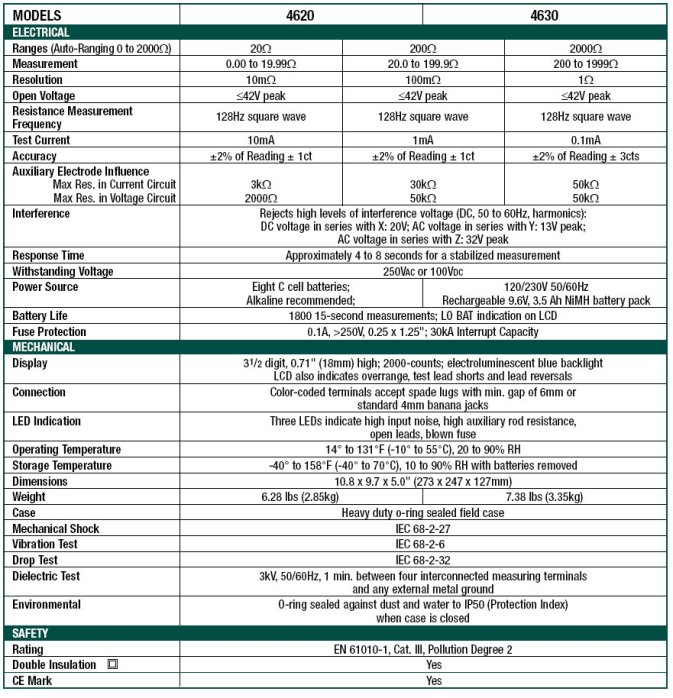
This tester measures from 0 to 2000 Ohm, and are auto- ranging, so it automatically seeks out the optimum measurement range. Easy-to-use: simply connect the leads, press-tomeasure and read the results. The large LCD (nearly 3/4" high characters) is easy-to-read, and also indicate low battery status, overrange, test lead shorts and lead reversals. Three LED indicators on the front panel continuously warn the user of measurement problems to ensure accurate and reliable tests. The 4620 is fuse protected up to >250Vac against accidental connection to live circuits. In the event of a system fault, they can withstand 250Vac with spikes of up to 3000Vac or 1000Vdc.
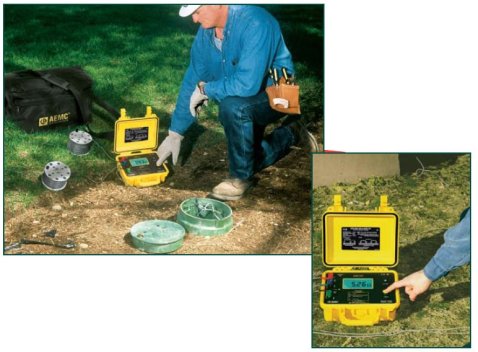
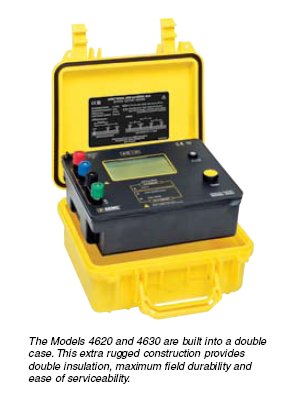
The heavy-duty field case is sealed against dust and water when closed. The meter itself is self-contained within an inner case providing additional environmental and insulation protection. The test button is also sealed against the elements. The meter is powered by eight, alkaline C cell batteries. Both models will perform over 2000- for the 15 second tests between recharging or battery replacement. The Ground Resistance Tester Model 4620 is a rugged, easy-to-use instrument ideal for maintenance crews performing numerous tests. Both models exceed mechanical and safety specifications for shock, vibration and drop tests called out in IEC standards. They are designed to reject high levels of interference, so they can be used under difficult conditions such as high stray currents that normally affect accuracy.
Features
-
Measures soil resistivity (4-Point) method
-
Measures ground resistance (2- and 3-Point) Fall-of-Potential method
-
Step voltage tests and touch potential measurements
-
Auto-Ranging: automatically selects the optimum resistance range
-
Designed to reject high levels of noise and interference
-
Extremely simple to operate: connect - press - read
-
LED on faceplate informs operator of high input noise, high auxiliary rod resistance and fault connections
-
Large easy-to-read backlit display
-
Battery powered
-
Rugged dustproof and rainproof field case
-
Can also be used for continuity tests on bonding
-
Color-coded terminals
-
Double Insulation
-
CE Mark
Applications
Three-Point measurements are generally used when the electrode or grid can be easily disconnected, if corrosion is suspected, or in circumstances where ground faults are unlikely to occur.
- Four-Point tests or soil resistivity measurements. Locating areas of lowest soil resistivity is essential for achieving an economical grounding installation.
- Touch potential measurements, an alternative to 3-Point tests in evaluating electrical safety. This test is recommended when the ground cannot be disconnected, where ground faults are highly likely to occur, or when the “footprint” of grounded equipment (the outline of the part of equipment in contact with the earth) is comparable to the size of the ground to be tested.
- Two-Point tests for continuity tests on bonding or on pre-established grounds. This test is commonly performed in urban environments where proper auxiliary electrode placement may be obscured by confined real estate. Measurements are referenced against a good local grounded circuit.
Technical Specifications
|
The Model 3640 comes with 3 color coded terminals to aid in easy hookup. Three LED indicators on the front panel continuously warn the user of measurement problems to ensure accurate and reliable tests.
|

The Analog Ground Resistance Tester Model 3620 performs ground resistance measurement from 0.5 to 1000Ω with speed and accuracy.
|

AEMC 4630 perform both ground resistance and soil resistivity tests and it measures from 0 to 2000 Ohm.
| |
Product Reviews
|
|